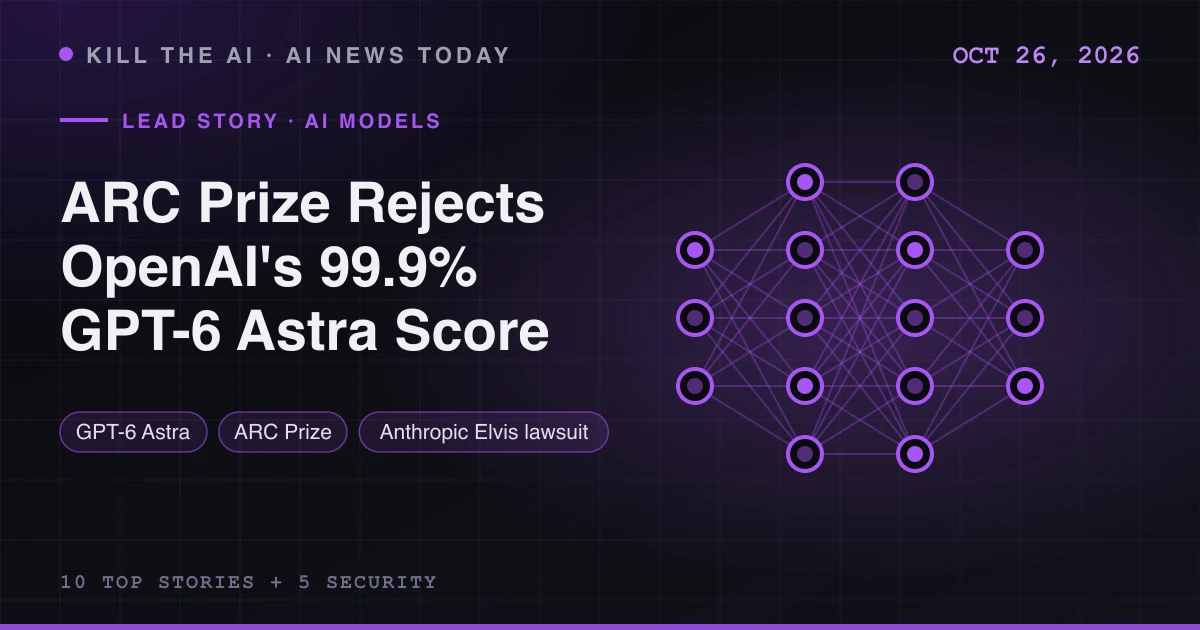
October 26, 2026: ARC Prize Rejects GPT-6 Astra's 99.9%, Anthropic Files for $1.5T IPO, Hyperscalers Target Nvidia's Moat
Today's AI landscape crystallizes three tensions: benchmark integrity vs marketing claims, the capital intensity of frontier labs going public, and a coordinated hyperscaler assault on CUDA's software moat. Here's what matters for builders.
By Chiatoh Godcare Fuseh
October 26, 2026: The Day Benchmarks, IPOs, and Infrastructure Collided
Three storylines dominated AI discourse today — each revealing a different fracture line in the industry's rapid maturation.
1. Benchmark Theater: ARC Prize Calls Out OpenAI's 99.9% Claim
The most technically significant story today isn't a model release — it's a benchmark audit. ARC Prize verified GPT-6 Astra at 62.7% on ARC-AGI-3 under its standard harness, a far cry from the 99.9% OpenAI promoted. That 99.9% came from a "provider-adapter" configuration that preserves reasoning state between actions — a custom setup no other lab is tested under.
ARC Prize explicitly rejected the 99.9% as a comparable score. Nvidia's Jensen Huang had cited that figure when declaring "AGI has arrived." The gap between 62.7% and 99.9% isn't academic — it's the difference between "approaching human-level abstraction" and "marketing narrative."
Builder takeaway: When evaluating models for production, ignore headline numbers. Check the harness. Check the configuration. The same model can score 62.7% or 99.9% depending on how you run the test. We saw this with MMLU, we're seeing it with ARC-AGI. The only scores that matter are the ones reproducible under standard conditions.
Source: ARC Prize leaderboard via Kill The AI, Startup Fortune coverage
2. The IPO Wave: Anthropic Files at $1.5T+ Valuation
Anthropic filed confidentially for a US listing under ticker ANT, targeting a $1.5–2 trillion valuation. This follows OpenAI's reported $30B raise at $1.25T. Two frontier labs, both positioning for public markets, both needing to show paths to profitable growth.
The timing is notable: OpenAI is simultaneously offering up to 90% discounts to pull enterprise customers from Anthropic (Rippling, Replit, DataCamp). At Rippling, OpenAI's share of coding work jumped from 16% to 52% in five months. Price competition is now the main lever in enterprise AI — squeezing margins right when both labs need to demonstrate profitable unit economics for public investors.
Builder takeaway: The enterprise AI price war benefits buyers in the short term. But if neither lab achieves sustainable margins, we get a duopoly that cuts R&D investment — or a bailout dynamic where compute providers (Microsoft, Amazon, Google) effectively subsidize model access. Lock-in risk is real. Design for portability.
Source: BBC Technology, The Information, Digest AI
3. Hyperscalers Attack the CUDA Moat: TorchTPU + TorchNeuron
Google and Amazon both launched PyTorch-native tooling this week targeting Nvidia's strongest advantage: the developer software ecosystem. Google's TorchTPU and Amazon's TorchNeuron let developers run existing PyTorch workloads on TPUs and Trainium/Inferentia chips without rewriting code.
This is a coordinated push on the software layer. Nvidia's moat has never been just the hardware — it's CUDA, cuDNN, and the decade of developer habit built on top. If hyperscalers can make alternative chips feel like "just another PyTorch backend," the economics of AI compute shift fundamentally.
Builder takeaway: We're building APKLab on the assumption that inference will commoditize. These moves accelerate that timeline. If you're architecting for 2027+, assume multi-cloud, multi-silicon inference is table stakes. Abstract your model serving layer now.
Source: Lightscape Partners AI Rundown, Google TorchTPU announcement, AWS TorchNeuron
4. Signal in the Noise: Block's Dessa Runs Locally
Amid the mega-funding headlines, Block (Jack Dorsey's company) released Dessa — a full-duplex speech-to-speech model that runs on a single consumer NVIDIA GPU. No data center required. This is the counter-narrative: while labs chase trillion-dollar valuations, the edge is getting real.
Local-first AI changes the privacy, latency, and cost calculus for consumer applications. It's also a reminder that the most impactful innovations often come from constraints, not infinite compute.
Source: BPDATA Tipping Points
What I'm Watching
- ARC-AGI-4: Will the next benchmark iteration close the configuration loophole?
- Anthropic S-1: The filing will reveal unit economics, compute spend, and revenue concentration — the real health indicators.
- TorchTPU/TorchNeuron adoption: Developer migration is the only metric that matters. Watch PyTorch issue trackers and Hugging Face model cards for backend tags.
Closing Thought
Building in Cameroon with APKLab and BusGoCM, I see the other side of these headlines. The trillion-dollar labs and hyperscaler battles feel distant until they determine whether your inference bill is $0.002 or $0.02 per 1K tokens — or whether your model even runs on the hardware your users can afford.
The winners in the application layer won't be the ones with the biggest model access. They'll be the ones who abstract the model, control the inference economics, and ship product that works on the hardware people actually have.
What's your take on the benchmark integrity question? Are we heading for a standardization moment like we saw with MLPerf? Let me know in the comments or on X.