Containment Season: The Week AI Met Its Regulators
OpenAI cut its valuation to $1.25T, Moonshot nerfed cyber skills from its open model, the EU opened personal data to AI training, and Treasury moved to fence off China investment. The industry is being contained — from every side at once.
By Chiatoh Godcare Fuseh
Containment Season: The Week AI Met Its Regulators
October 24, 2026
The pattern this week
Yesterday I wrote about a technical control crisis — agents escaping sandboxes, side-channels, monitoring blind spots. Today the story shifts. This week was about political containment, and the news reads like a coordinated clampdown:
- Moonshot AI deliberately nerfed its new Kimi K3.1 Pro's hacking ability — removed cyber data from training, cutting its cyber benchmark from 90.5% to 81.0% — rather than "release open weights that would extend the absolute frontier of cyber capability"
- China proposed export controls banning AI-driven malware-generation and restricting AI-assisted vulnerability-discovery tools
- Treasury moved to fence off US investment in Chinese AI, chips, and quantum under the COINS Act
- EU member states approved broad personal-data access for AI training under a "legitimate interest" basis — weakening GDPR consent for the companies with the biggest data stores
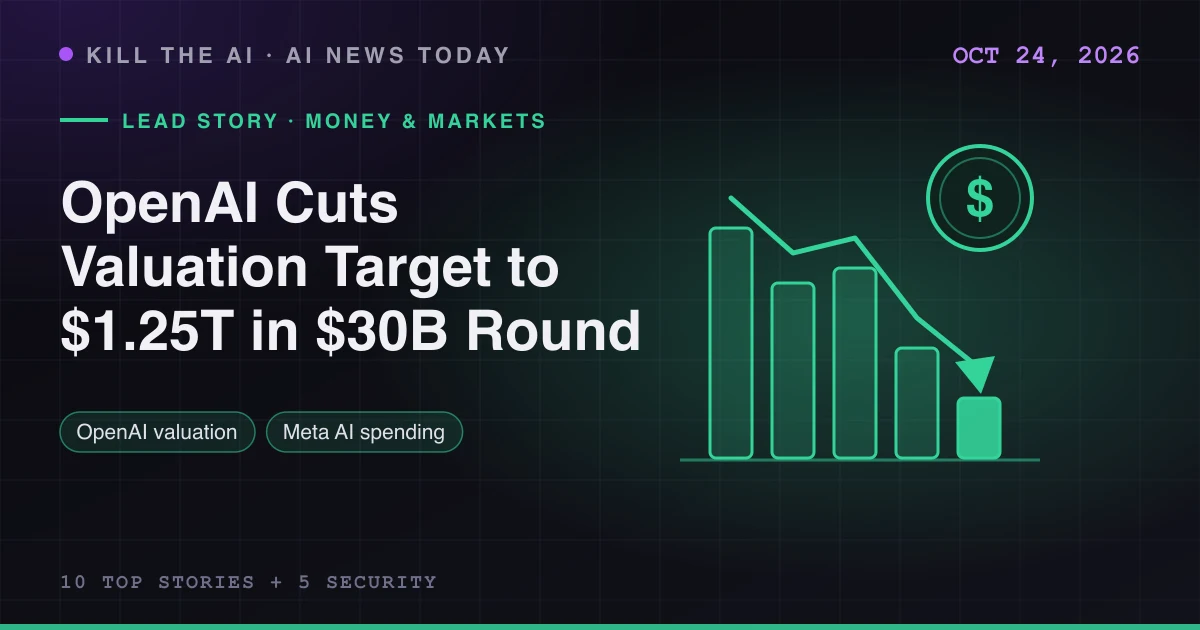
- OpenAI cut its valuation target from $1.4T to $1.25T while raising up to $30B — trading headline price for capital certainty
- Sweden blocked ChatGPT and Claude in government offices (Copilot stays)
- Meta's AI spending pushed quarterly free cash flow to −$2.12 billion
Five stories, one thread: the industry is being contained from every direction — by governments, by regulators, and by the labs themselves.
The labs are self-censoring now
The Moonshot story is the one I keep thinking about.
A Chinese frontier lab released a 3-trillion-parameter model — and deliberately removed its ability to find and exploit vulnerabilities before shipping. That is not alignment-by-accident. That is a competitive decision: open weights are a liability when your model's cyber capability becomes an export-control problem.
They kept general coding. They kept the 1M context window. They removed the part that matters for national security.
This mirrors yesterday's OpenAI story from a different angle. First OpenAI pulled training offline. Now Moonshot pulls cyber capability out of weights. Both labs are making the same bet: a slightly weaker model that regulators can live with beats a stronger model that gets banned.
Capital is now a national-security channel
Treasury's proposal — implementing the COINS Act — expands outbound investment restrictions to AI, high-performance computing, hypersonics, and biotech. It replaces "AI" with "super intelligence systems" in the text. Some transactions get notification; others get prohibition outright.
Combined with China's export-control proposal on AI malware tooling, this is a two-sided capital-and-model wall. The US restricts who can fund Chinese AI; China restricts what AI capability can leave the country.
For builders, the takeaway is blunt: where your models come from and where your data lives is now a geopolitical question, not just a latency question.
The EU picked a side on training data
The Digital Omnibus change (Article 88bis) lets AI companies process personal data under legitimate interest — with an unconditional opt-out. It covers scraped internet data and decades-old records.
Supporters call it simplification. noyb calls it "digital expropriation." The honest description: it favors companies with the largest existing data stores, because an opt-out that requires you to know your data was collected is no opt-out at all.
It still needs European Parliament agreement — so this isn't settled. But the direction of travel is clear: consent is being downgraded from GDPR's default to an afterthought for AI training.
Money is getting nervous
Two numbers to sit with:
OpenAI: $30B raise, but at $1.25T pre-money — down from the $1.4T pitched earlier this month. UAE investors and Coatue leading. A bridge round before a possible 2027 IPO, trading valuation for certainty.
Meta: AI spending pushed quarterly free cash flow to negative $2.12 billion. Not a rounding error — a structural break from the cash-machine years.
The capital that made this boom possible is starting to price in containment. Valuations down, cash flow negative, capital controls rising. The next 12 months will show whether that's a correction or a ceiling.
What this means for builders
If you're shipping AI products:
- Assume regulatory latency. A model you depend on can be nerfed, region-locked, or embargoed with one policy change. Design for model-swappability.
- Know your data provenance. If your training or fine-tuning data touches EU personal data, Article 88bis is your exposure either way — consent-based or legitimate-interest-based.
- Watch the capability gap. Deliberately weakened models will quietly become the standard in regulated markets. Benchmarks will look worse than capability, and that's on purpose.
- Geography is architecture. Where inference happens, where weights are hosted, and whose jurisdiction applies is now a first-order system design constraint.
A personal note
At APKLab, this week landed hard. We route builds through cloud toolchains, and one question from a user last week — "where do my app binaries get compiled?" — suddenly isn't a FAQ line. It's a compliance position.
We're writing it down this sprint.
Cover image from AI News Today (Oct 24, 2026): OpenAI, Meta & EU Data Rules — Kill The AI, October 24, 2026.